faraday bag, also known as a shielded cell phone bag, protects much more than just a cellphone. These bags are designed to block electromagnetic waves from entering. They are built with mesh or continuous metal. They work by surrounding the object with a conductive metal mesh so an electromagnetic field cannot harm it.
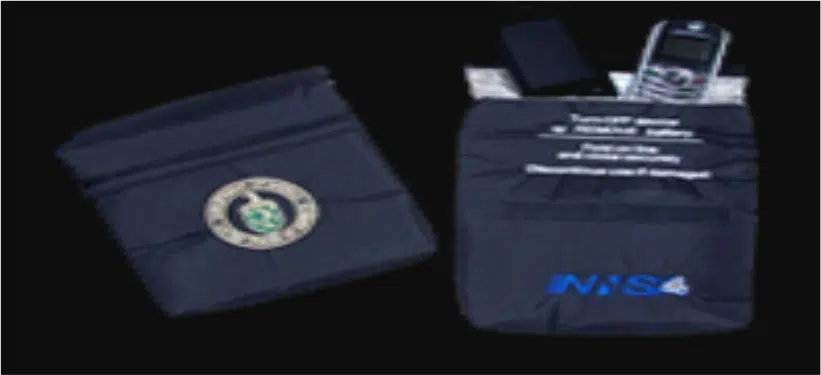
Many choose to use a shielded cell phone bag to protect their data. Faraday bags are also used by car owners with key fobs. If you use a keyless entry system, a Faraday bag can help prevent criminals from copying your car key. Taking this extra step to protect your key fob will help prevent auto theft.
From car keys to cell phones to laptops, Faraday bags protect important valuables. You want to ensure that the personal data in these devices stay that way. You do not want hackers to be able to access your data. It’s crucial to ensure that your bag works properly every time you take it out.
While Faraday bags are effective at protecting your data, they can be damaged. Bags with holes or worn-out materials will allow signals to break through. It’s important to check your bag for any signs of damage when you first purchase it and to check periodically to ensure its integrity. Luckily, there is a way to check if your shielded cell phone bag is working. Place your phone in the bag and call it with another device. If the call goes through, your bag has been compromised.
In environments where digital devices are treated as evidence, isolation is not a convenience; it is a control. The moment an RF shielding pouch enters a forensic or security workflow, it becomes part of the preservation chain. At that point, performance is no longer implied by design or construction; it must be demonstrated.
At JEMIC, we treat RF isolation products the same way we treat any EMI shielding solution. If performance cannot be verified, it cannot be defended. Testing is what turns RF isolation from a product claim into a defensible engineering control, because shielding performance without repeatable, standards-aligned verification creates false confidence, failed deployments, and documentation that collapses under scrutiny.
That expectation is not theoretical. It is built into how evidence handling organizations describe preservation risk and mitigation.
Why Testing Matters in Digital Evidence Preservation
Digital devices are networked systems by default. They transmit, receive, synchronize, and respond to external signals. In forensic workflows, that behavior creates risk because connectivity can change what is on the device and what the device does.
Electronic Crime Scene Investigation: A Guide for First Responders, Second Edition (National Institute of Justice, 2008) recommends RF shielding materials, such as Faraday isolation bags, to prevent communications that could alter evidence, and warns that devices removed from shielding or packaged incorrectly may resume communications when a signal is present.
Similarly, the INTERPOL Global Guidelines for Digital Forensics Laboratories (INTERPOL, 2019) recommend blocking network signals because devices may automatically attempt to connect, which can modify stored data, and it presents Faraday rooms, boxes, and bags as isolation methods in mobile evidence workflows.
Once RF isolation becomes part of evidence preservation, the enclosure is no longer an accessory. It is a preservation control. That means it must perform reliably under defined conditions.
At JEMIC, we do not treat a shielded device pouch as something that “probably works.” We treat it as an assembly whose performance must be validated. The relevant question is not whether a device looks disconnected in a casual scenario. The relevant question is whether the enclosure delivers measurable attenuation across relevant frequencies, in realistic configurations, with repeatable results. That shift, from appearance to proof, is where engineering discipline begins.
Why Testing Matters More Than Claims
Shielding claims are inherently conditional. Performance depends on frequency, geometry, coupling paths, and discontinuities.
Guidelines on Mobile Device Forensics (NIST, 2014) explains that Faraday containers may attenuate signals but not necessarily eliminate them completely, and it identifies practical failure modes such as improper sealing and cables acting as antennas. That distinction matters. Attenuation is measurable. Elimination is absolute. In practice, shielding reduces coupling; it does not guarantee zero communication under all conditions. Flexible enclosures also introduce variables that rigid, bonded structures do not, especially at closures and interfaces.
Best Practices for Mobile Device Evidence Collection, Preservation, Handling, and Acquisition (SWGDE, 2025) cautions that RF shielding containers are not always fully effective and instructs teams to regularly test them to confirm effectiveness.
From our perspective as an EMI shielding manufacturer, that guidance reinforces a straightforward point. A shielding pouch cannot be defended by anecdote. A device failing to ring inside an enclosure does not quantify attenuation. It does not evaluate multiple radios. It does not stress closure integrity. It does not tell you what happens when orientation changes, when the closure is not perfectly aligned, or when the device attempts to communicate using a different band.
A defensible product claim must be tied to controlled measurement and documented results. That is the foundation of verification.
What Counts as Proof of Shielding Performance
Proof is not a label. Proof is clear alignment between a requirement and a measurement method. And so, a shielding claim only holds up when it clearly states what was tested and what “pass” means. That includes:
- the frequency range evaluated
- the minimum attenuation threshold required
- the configuration under test, including how the closure was positioned
- the measurement method used
- repeatability across multiple runs
Standards bodies have formalized why this matters, especially for small enclosures.
IEEE 299.1-2013 (IEEE Standards Association, 2013) provides procedures tailored to smaller enclosures and distinguishes them from room-sized shielding structures. That reflects a technical reality. Small enclosures behave differently, and verification must match the geometry and measurement challenges of that size class.
At the material level, ASTM D4935-18 (ASTM International, 2018) specifies a standardized method for measuring the electromagnetic shielding effectiveness of planar materials under defined conditions. That method is valuable for validating conductive layers or laminates and for building traceability into the material side of a shielding program.
However, planar material performance does not automatically translate to finished enclosure performance. Seams, folds, closures, and mechanical interfaces introduce discontinuities that are absent in flat coupon tests.
At JEMIC, we deliberately separate these two levels. Material qualification validates the shielding layer itself. Enclosure verification validates the finished RF isolation assembly. A shielded pouch is not a flat sample; it is an assembly. Its performance must be evaluated as an assembly. That distinction defines the path forward.
The Verification Stack Organizations Use for Faraday Bags
Testing credible shielding products follows a hierarchy. Each level answers a different question. Together, they convert a product claim into defensible documentation.
Screening Versus Verification
Screening checks can identify obvious compromises. They cannot establish compliance. As noted in Guidelines on Mobile Device Forensics (NIST, 2014), attenuation does not necessarily mean elimination, and improper sealing can undermine isolation. A behavioral check reflects one protocol, one frequency, and one environment. It does not measure shielding effectiveness across bands. It does not quantify attenuation. It does not establish repeatability.
SWGDE’s 2025 guidance reinforces that RF shielding containers are not always fully effective and should be tested regularly. The emphasis is on confirmation through testing, not assumption through observation. At JEMIC, we treat screening as an indicator, not proof. It can suggest a problem. It cannot substantiate a claim.
Quantifying Material Performance
Material-level testing establishes the baseline performance of the conductive layer. ASTM D4935-18 (ASTM International, 2018) provides a controlled method for measuring attenuation of planar materials across defined frequencies. Under defined laboratory conditions, it produces traceable, repeatable numbers.
For manufacturers, this step supports supplier qualification and production consistency. It verifies that the shielding laminate or fabric meets electrical performance targets before integration. It also provides a reference point when investigating discrepancies between expected and observed results.
However, material performance does not equal product performance. Sewing, folding, bonding, and closure integration introduce discontinuities. The closure system can become the limiting factor even when the base layer performs well. Material qualification is necessary. It is not sufficient.
Enclosure Level Verification for Small Enclosures
Finished shielding pouches are electrically small enclosures. Geometry, apertures, seams, and closure systems dominate performance, especially as frequency increases and coupling paths become more sensitive to discontinuities.
IEEE 299.1-2013 (IEEE Standards Association, 2013) addresses measurement procedures specific to smaller enclosures. Measurement configuration, antenna placement, and frequency selection influence results, which is why a valid test must be designed and documented, not improvised.
Research on electrically small enclosures shows that aperture shape and measurement setup affect observed shielding characteristics and that multiple configurations may be required to characterize performance credibly. Flexible enclosures add additional variables. Closure alignment, compression pressure, seam continuity, and fold geometry influence leakage paths. A test that ignores these factors produces incomplete data.
For this reason, enclosure-level verification must evaluate the finished product in configurations that reflect actual closure conditions. It should document the frequency ranges tested, the test geometry, the closure positioning, and the measured attenuation. It should be repeatable across runs and across samples when the claim applies to production.
At JEMIC, this is where product design and verification converge. Layer count, conductive continuity, seam construction, and interface integrity are stressed intentionally because that is where shielding succeeds or fails. Without testing the assembly, performance cannot be assumed from materials alone.
Partner with JEMIC To Validate Performance That Holds Up
If your shielding enclosure is used to protect evidence integrity, sensitive workflows, or controlled environments, performance cannot be taken for granted. It has to be measurable, repeatable, and documented in a way that holds up under challenge.
That is how we approach RF isolation at JEMIC. We treat these products as engineered assemblies, not accessories. We separate material qualification from finished product verification, and we focus testing where failures actually occur, at seams, closures, and interfaces. The goal is straightforward: results you can stand behind, not outcomes that depend on a perfect scenario.
If you need RF isolation solutions that are built and validated for professional use cases, partner with JEMIC. We will align the requirement with the appropriate verification approach, validate performance at the assembly level, and support deployments with documentation that meets institutional standards.